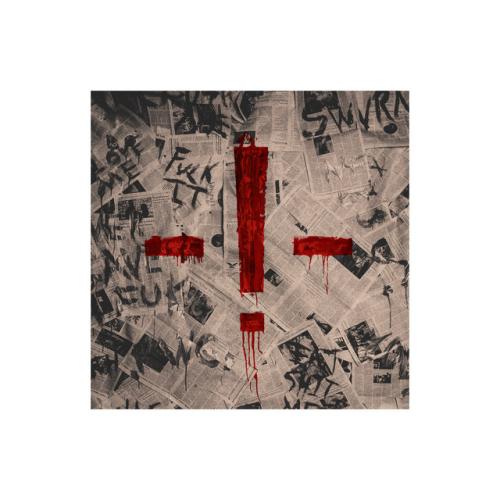
The Boy Who Died Wolf
The Boy Who Died Wolf is more compelling when Highly Suspect commit to a mood than when they try to advertise their range. The album moves between thick guitar rock, atmospheric passages, electronic experiments and a piano ballad. Johnny Stevens can hold the different sounds together with his voice, but the songs vary in how much purpose they give that voice.
“My Name Is Human” makes a strong opening. The riff has a slow, heavy pull, and Stevens' restrained, rhythmically pointed delivery makes the later release feel substantial. “Look Alive, Stay Alive” then supplies a short, aggressive change in pace. The contrast is valuable: the band sounds more alive when its different approaches answer one another. “Little One” has a more familiar melodic shape, but the hook is strong enough to make that directness work.
“Serotonia” takes a longer route through the band's uneasy, grunge-influenced sound. Its atmosphere is more convincing than some of the provocative language, which can draw attention away from the feeling underneath. “Viper Strike” has a similar problem when its anger becomes deliberately crude instead of more precise. The electronic repetition of “F.W.Y.T.” is a weaker detour, offering less development than the surrounding full-band material. The record's willingness to try things is welcome, but not every experiment produces an interesting song.
The final pair gives the album a better destination. “Chicago” exposes Stevens through piano and a much more theatrical vocal, while “Wolf” develops from a gentle opening into an extended, forceful guitar ending. The latter earns its scale through a clear progression and gives the musicians room to do something beyond supporting another chorus. The Boy Who Died Wolf remains uneven, with several ideas that work better in isolation than in sequence. Its stronger songs nevertheless show real control of tension and release. “Wolf” is the clearest success because the ambition grows from the arrangement itself rather than the attitude surrounding it.